Inside the AI-to-Human Handover: How Context Persists Across Agents, Systems, and Channels
Inside the AI-to-Human Handover: How Context Persists Across Agents, Systems, and Channels
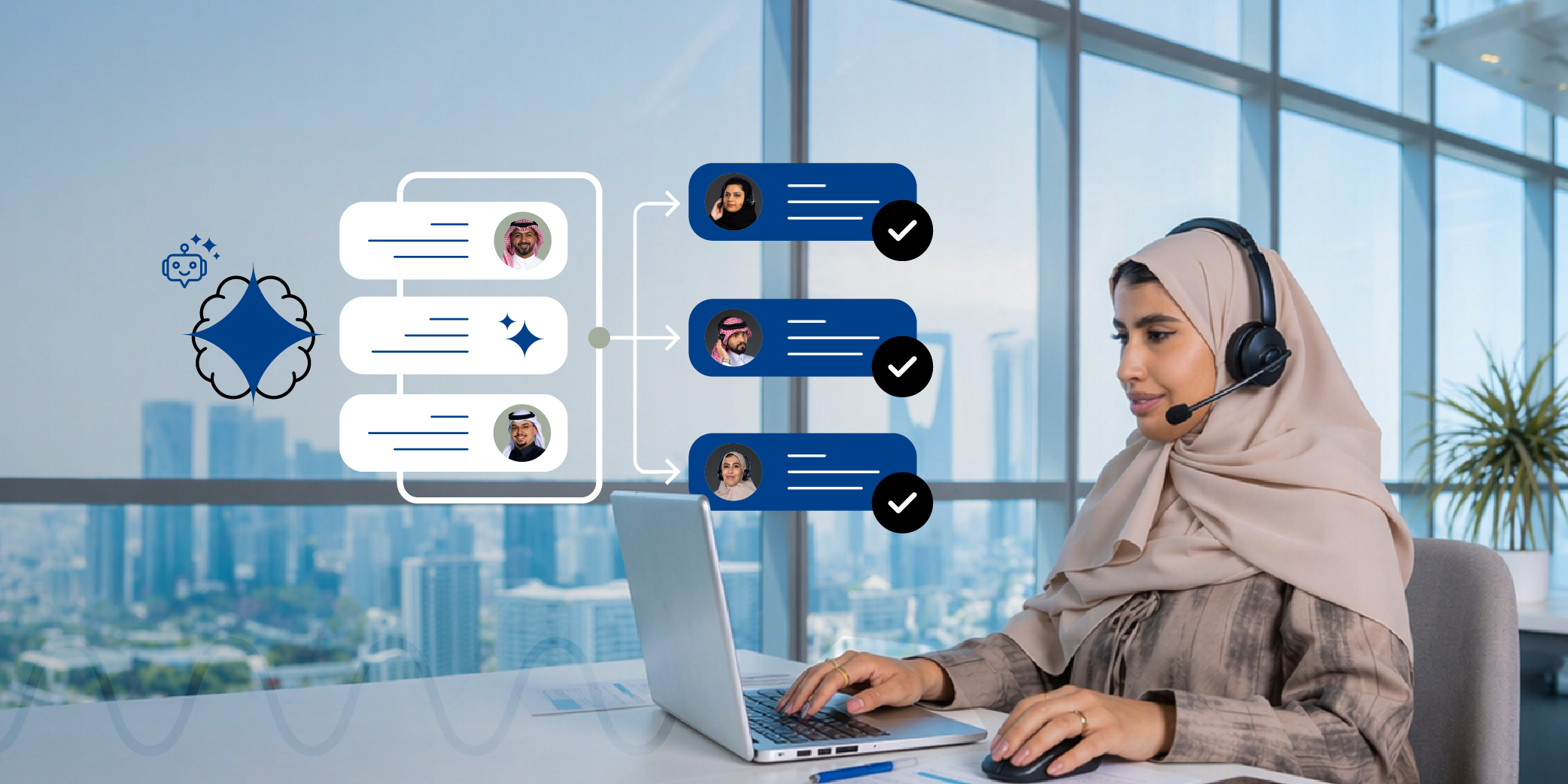
Explore how structured context, AI-agent orchestration, enterprise integrations, intelligent routing, and Agent Co-Pilot work together to carry customer intent and action history into the live-agent experience.
A Seamless AI Handover Is a Systems Problem
A successful AI-to-human handover is not a single transfer event. It is a coordinated process involving the conversation channel, AI agent, customer profile, knowledge sources, operational systems, routing logic, agent workspace, and governance controls.
By the time a human agent joins, the platform must have preserved more than the words exchanged. It must also carry forward the customer’s intent, verified information, current case state, actions already taken, relevant system outputs, escalation reason, and the next step required.
This is where agentic architecture differs from a conventional chatbot integration. AI agents can reason through a request, retrieve information, call connected tools, execute actions, and transfer the interaction to a human when judgment or approval is needed. The live agent receives the conversation with the relevant context and system outputs already available
A handover is a state transition, not a transcript transfer
Many organizations believe that solving the handover problem simply means sending the entire chat history to the human agent. However, research from XTrace warns against the Context Dump Fallacy. This is the mistaken belief that more raw data leads to better outcomes. When an agent receives a massive log of fifty messages, they often fall victim to the Lost in the Middle effect. This means they miss critical signals buried in the text because they are scanning for facts quickly.
A technically complete handover combines conversational context with operational state. The conversation tells the agent what was said. The state tells them what has already been verified, which systems were consulted, what actions were completed, what remains unresolved, and why human involvement is now required.
The context layer: short-term state, long-term memory, and grounded knowledge
Context persistence operates across three complementary layers.
Short-term interaction state tracks what is happening in the current case: the customer’s immediate goal, actions already taken, channel, urgency, priority, and escalation conditions.
Long-term customer and case memory provides the wider relationship context: customer profile, previous cases and outcomes, preferences, entitlements, product history, and service commitments.
Grounded enterprise knowledge connects the interaction to approved policies, troubleshooting guidance, and operational procedures. Rather than relying on the language model alone, Retrieval-Augmented Generation can retrieve relevant information from enterprise documents and knowledge sources using semantic and keyword search
How multi-agent orchestration supports the handover
In an agentic architecture, a request can be decomposed across specialized AI agents. One agent may classify the intent, another retrieve account information, another validate policy, and another execute an action in a connected system. Coordination determines whether the request can be completed autonomously or whether it should move to a human.
The technical value of this approach is not simply greater automation. It creates a traceable chain of context and actions that can accompany the handover. The human agent can see not only the customer’s request, but what the AI attempted, which information it used, and why the case was escalated.
Tool orchestration and backend system connectivity
Context cannot persist if it is trapped inside the conversation platform. The AI-agent layer must connect securely to the systems where customer and operational truth resides.
During an interaction, agents may retrieve account details, consult approved knowledge, validate identity, update a CRM record, create or amend a ticket, initiate a transaction, or trigger a workflow. The resulting system outputs become part of the case context.
This means the human handover does not begin with a search across systems. It begins with a consolidated view of the conversation, customer, action history, and unresolved task.
Routing is part of context orchestration
The handover decision is not only a matter of whether the AI can answer. Routing logic must determine why human intervention is required and who is best placed to continue.
A case can be routed according to intent, skill requirements, language, urgency, team structure, agent availability, or the need for approval. The selected agent should receive the interaction together with the escalation reason and the relevant context, replacing a blind queue transfer with a context-aware assignment.
What the agent receives in the Contact Center
At the point of handover, the context layer becomes visible inside the agent workspace. The agent receives the conversation history, customer and case information, AI-generated summary, and guidance relevant to the live interaction.
This is where the distinction between the AI agent and Agent Co-Pilot becomes important:
- The AI agent handles or progresses the customer request autonomously.
- The human agent takes authority when judgment, empathy, approval, or exception handling is required.
- Agent Co-Pilot supports the human with summaries, suggested responses, contextual guidance, and next-best actions.
What happens after the handover
Context continuity does not end when the live conversation closes. Post-session workflows can update the CRM, create or close tickets, trigger follow-up actions, send surveys, and make the resulting information available to future interactions.
This closes the context loop. The next AI agent or human agent starts with the outcome of the previous interaction, rather than reconstructing it from incomplete notes.
Add a technical trust and governance layer
Because handovers may involve identity data, account information, operational actions, and regulated decisions, context persistence must be governed rather than merely comprehensive.
Inputs can be checked for prompt-injection risks, sensitive data masked where applicable, and outputs validated against policy and brand controls. Sensitive or irreversible actions can pause for human approval.
Actions and escalations should also remain visible and traceable so support leaders can understand what the AI did, why it acted, where a human intervened, and whether the intended outcome was achieved.
Context That Can Be Acted On
A seamless AI-to-human handover is not created by moving a transcript from one screen to another. It depends on an intelligence and orchestration layer that preserves interaction state, retrieves trusted knowledge, connects to operational systems, records actions, applies routing logic, and presents the human agent with a clear path forward.
Within Agentic Care, AI agents can understand, reason, plan, act, and escalate, while human teams retain authority at critical moments. Agent Co-Pilot then supports the live agent with summaries, grounded recommendations, and next-best actions. After the interaction, workflow automation updates the systems that will inform the next customer moment.
That is the real measure of contextual persistence: every AI agent, human agent, channel, and system continues from the same customer journey rather than starting a new one.

Related articles
27 July 2026
From automation to agency: Agentic AI shapes next era of customer experience
05 May 2026